61 N. Hampstead Village Dr., Hampstead, NC 28443

Most people worry about the wrong sound.
A jaw that clicks gets attention. It’s audible, it’s annoying, and it feels like something is breaking. So that’s what brings people into our Henderson Drive office.
But a clicking jaw, on its own, is usually not the urgent problem. The urgent problem is the click that stops.
Clicking Is Common. That’s What Makes It Confusing.
Roughly one in three adults between 18 and 55 has a jaw joint that clicks or pops. A global review of TMD research found joint sounds in 29.8% of people studied. Plenty of those folks will never need a day of treatment.
Here’s the mechanism. A small disc of cartilage sits between your jawbone and your skull. If it slides forward when your mouth is closed and snaps back into place as you open, you hear a click. Clinicians call that disc displacement with reduction. The disc is still doing its job, just noisily.
Painless, stable clicking often calls for monitoring rather than intervention. That’s an honest answer, and it’s not one you’ll hear from a practice selling a device.
The Warning Sign Almost Nobody Recognizes
Now picture that same jaw going quiet.
The click you’ve had for six years disappears. At the same time, your mouth won’t open as wide, and it hurts.
That combination has a name: closed lock, or disc displacement without reduction. The disc has slipped forward and stopped coming back, so it now blocks the joint like a sock jammed behind a drawer.
Three signs travel together:
- A history of clicking that has recently stopped
- Reduced opening, often 30mm or less when normal is above 40mm
- Pain, and the jaw pulling toward the affected side as you open
A quick self-check: stack three fingers vertically and try to fit them between your front teeth. Most people can. If you can’t, and you used to, that’s worth an exam.
Limited opening is the least common TMD presentation, showing up in about 8.1% of cases. That rarity is exactly why it gets missed. Timing also matters here. Cases caught inside six months respond far better to conservative repositioning than cases that have been quietly ignored for two years.
When Headaches and Ear Pain Are Actually Your Jaw
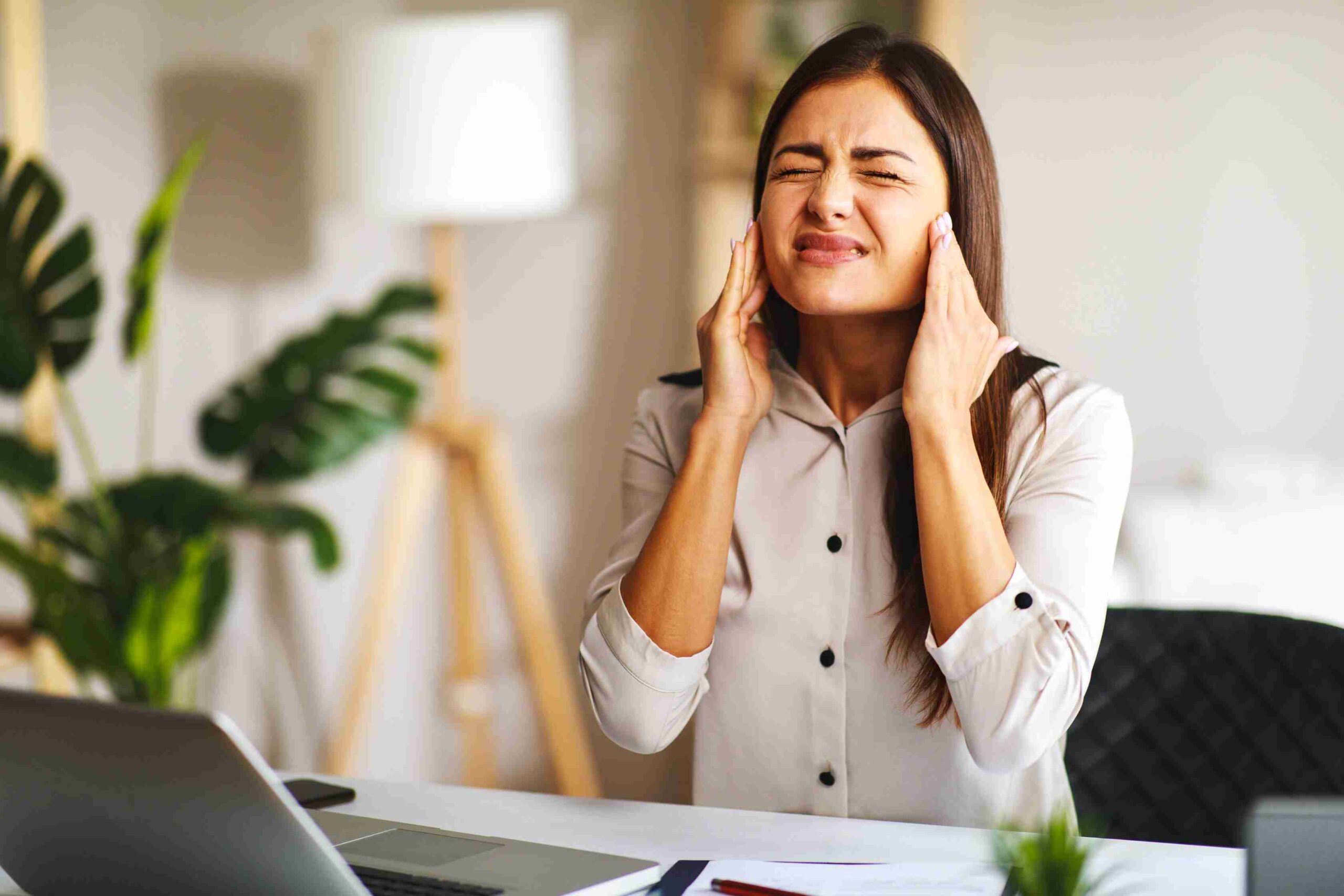
Temple headaches that are worse on waking. Ear pain and fullness with a clean ear exam. Facial soreness that shifts sides.
We meet people in Jacksonville who have cycled through urgent care two or three times for an ear infection nobody could find. The joint sits directly in front of the ear canal. When it’s inflamed, your brain often reads it as ear pain.
This isn’t a minor complaint, either. Patients rate TMD pain around 4.3 out of 10 on average, comparable to how people rate chest and back pain. Nationally, TMD accounts for an estimated 17.8 million lost work days per year for every 100 million working adults.
One more connection worth knowing: as many as one in four people with TMD also have obstructive sleep apnea. If you’re clenching all night and waking up tired, those two things may be talking to each other. We evaluate sleep apnea here as well.
Why We See More of This in Onslow County
There’s a documented reason jaw pain shows up more often around a base town.
A 2023 meta-analysis in the Journal of Oral Rehabilitation compared war-exposed individuals with PTSD against people without that exposure. TMD signs appeared in 56.2% of the exposed group versus 20.18% of controls, more than double the risk. Bruxism, the clenching and grinding that drives much of this, affects somewhere between 8% and 31% of US adults generally.
Deployment cycles, field time, PCS orders, and the ordinary weight of military family life all show up in the jaw muscles. Patients from Sneads Ferry, Swansboro, Richlands, Hubert, Piney Green, and Holly Ridge tell us some version of the same story: they didn’t notice they were clenching until something hurt.
That’s not a weakness. It’s a physiological pattern with peer-reviewed literature behind it.
What an Evaluation Actually Involves
Less than people expect.
We measure your opening range in millimeters, palpate the joint and the muscles around it, watch how your jaw tracks as it opens, and listen for what the joint is doing and when. Imaging comes into it only when findings warrant it.
Conservative and reversible treatment comes first, every time. Most jaw problems settle within weeks to months. Surgical options belong at the end of the list, not the beginning.
We’ll also tell you when this isn’t our lane. Some facial pain belongs with an orofacial pain specialist, an ENT, or your primary care provider, and saying so is part of the job.
Schedule a complimentary consultation at our Jacksonville or Hampstead office. No referral needed. You can also meet Dr. Mancini or read more about TMJ-TMD care before you come in.
Frequently Asked Questions (FAQ’s)
Is jaw clicking without pain something to worry about?
Painless, stable jaw clicking affects about a third of adults and usually needs monitoring rather than treatment.
When does jaw clicking become an emergency?
Seek evaluation when long-standing clicking suddenly stops and your mouth won’t open as far, which can signal a closed lock.
Can TMJ problems cause headaches and ear pain?
Yes, TMD commonly produces temple headaches and ear pain or fullness, which is why many patients are first treated for ear infections.
How wide should you be able to open your mouth?
Normal mouth opening exceeds 40mm, roughly three stacked fingers between the front teeth, and under 30mm suggests restricted joint movement.